Give your mind a place to land.
Follow the sound. Notice the sensation. Return your attention to the present. Music you enjoy can ease anxiety; the blanket adds a physical point of focus to the listening experience.
Music and anxiety SoundBlanket
SOUND · VIBRATION · STILLNESS
Vibroacoustic therapy,
made personal.
Sound you hear. Vibration you feel. A space to unwind.
Discover the benefitsDiscover the experience at
Salt & Reef Wellness Spa
THE EXPERIENCE
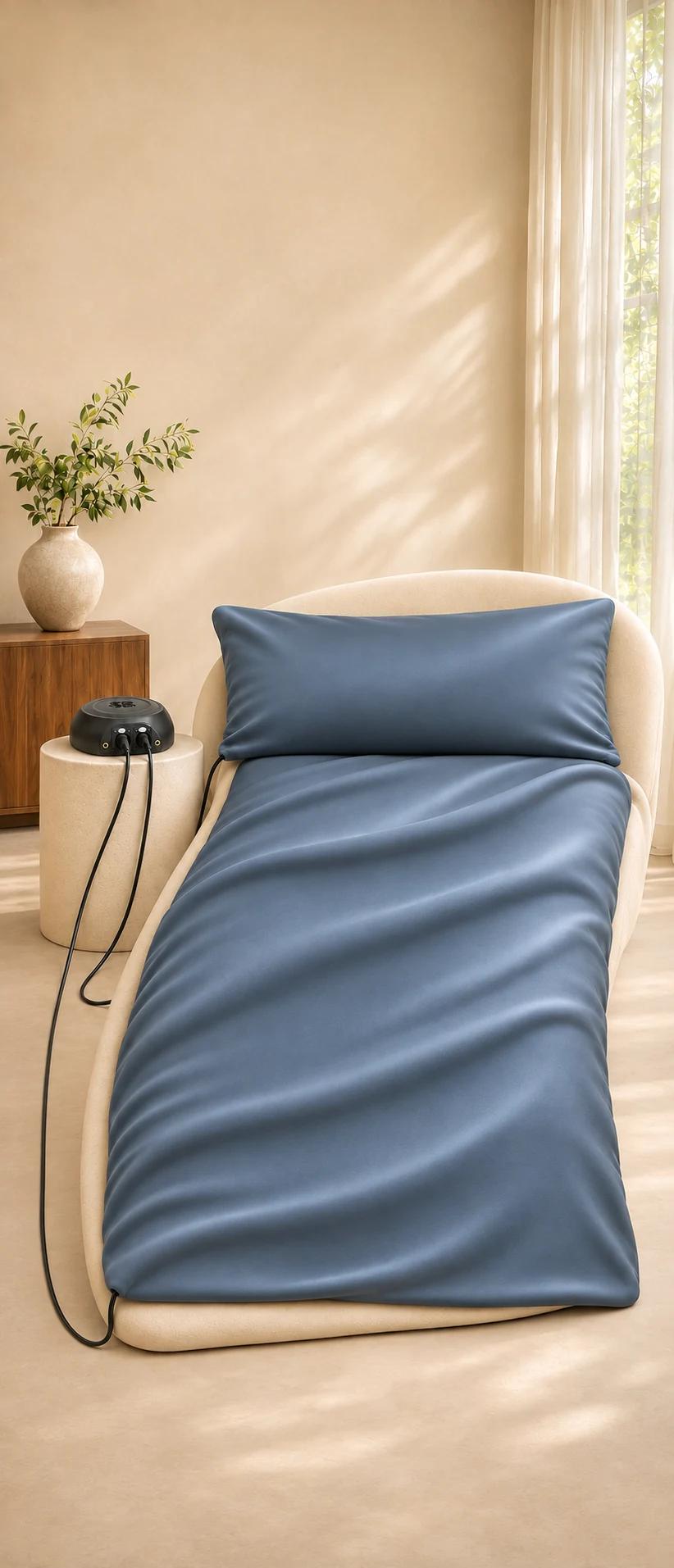
In a session, you listen to music while low-frequency sound travels through you. A sustained note can feel like a soft hum, a drumbeat like a gentle pulse.
WHY MAKE TIME FOR IT
Sound Blanket is a tool for making relaxation a practice. Sound and vibration offer a point of focus for your attention, whether you’re meditating or taking time to unwind.
Follow the sound. Notice the sensation. Return your attention to the present. Music you enjoy can ease anxiety; the blanket adds a physical point of focus to the listening experience.
Music and anxietyHear the melody and feel the lower notes move through the fabric. This is listening through touch as well as sound. Vibroacoustic research has recorded changes in heart rate and heart-rate variability consistent with relaxation.
Vibration and relaxationChoose familiar music, a meditation, or ocean waves. As part of a regular routine, Sound Blanket gives you a way to practice returning your attention to the present and becoming more familiar with the feeling of rest.
Music and sleep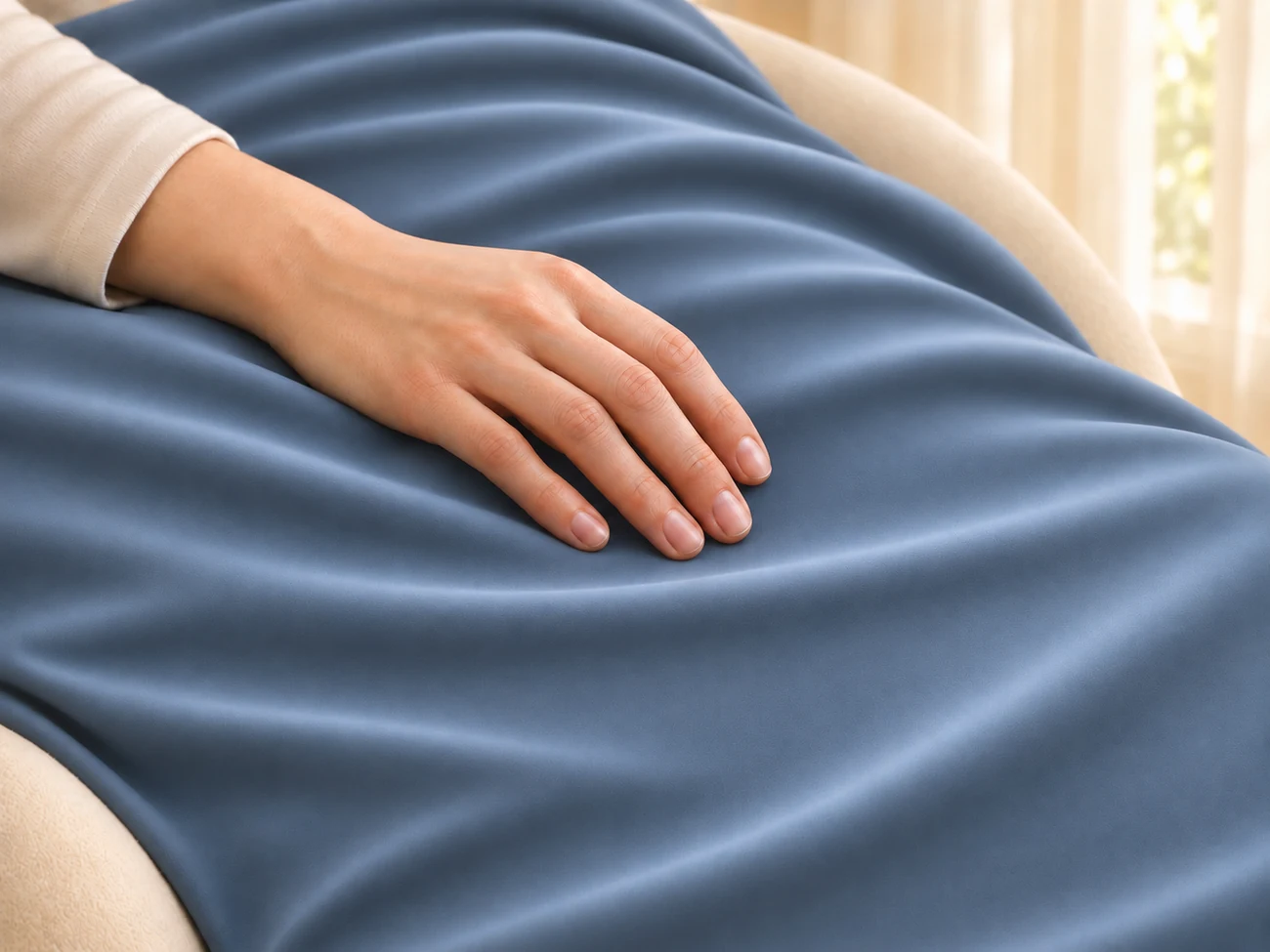
THE BODY’S RETURN TO REST
Even after the room goes quiet, your body can take a moment to settle. Your nervous system helps you rise to a challenge and recover when it passes.
As the stress response eases, your parasympathetic nervous system helps slow your breathing and heartbeat. That return to rest gives your body time to recover between the demands of the day.
Explore the researchVIBROACOUSTIC THERAPY AND RELATED MUSIC RESEARCH
Researchers have studied vibroacoustic stimulation, music listening, and clinical music therapy across these seven areas.
The findings below come from specific therapeutic approaches, equipment, and protocols. They do not establish disease-treatment outcomes for Sound Blanket.
01
VIBROACOUSTIC THERAPY
A small study of autistic children found improved joint attention following a series of vibroacoustic sessions. Children also described calm and enjoyment during the experience.
The 2025 pilot recruited 18 children aged 9–12 into two matched groups. The intervention used a vibrating mat and headphones for ten 20-minute sessions. Joint attention improved; broader auditory-attention measures did not show a treatment effect. This was an exploratory controlled pilot.
Moore et al. · Healthcare · 202502
MUSIC THERAPY AND VIBROACOUSTIC MINDFULNESS
Trauma-focused music therapy has reduced PTSD symptoms in randomized clinical research. A separate study found that breath-synced vibration during mindfulness improved body awareness and sustained attention in trauma-exposed women.
The PTSD trial involved 45 women receiving 12 weekly sessions of therapist-led group music and imagery or a waitlist comparison. The vibroacoustic study involved 65 women with dissociative symptoms who completed six mindfulness sessions; an amplified breath signal drove a small subwoofer worn on the sternum. These were distinct therapeutic approaches and outcomes.
Rudstam et al. · European Journal of Trauma & Dissociation · 2022 Fani et al. · Psychological Medicine · 202303
CLINICAL MUSIC THERAPY
Therapist-led music therapy reduced anxiety in a 300-person clinical trial. Its anxiety improvements met the study’s criteria for being comparable to cognitive behavioral therapy.
Cancer survivors with anxiety received seven weekly telehealth sessions with a board-certified music therapist or cognitive behavioral therapy. The randomized study assessed outcomes at eight and 26 weeks and met a prespecified noninferiority criterion. This was individualized clinical treatment, rather than passive music listening.
Liou et al. · Journal of Clinical Oncology · 202604
VIBROACOUSTIC MUSIC ADDED TO USUAL CARE
A clinical study found that adding vibroacoustic music sessions to usual depression care improved depression and perceived-stress scores over four weeks.
Researchers randomized 66 inpatients, with 61 completing the study. The added sessions lasted 30 minutes, three times weekly, using a somatosensory music chair. The comparison group received usual psychiatric treatment and nursing. There was no music-only or attention-matched sham group, and longer-term effects were not established.
Wang, Xie & Du · International Journal of Mental Health Promotion · 202405
COMBINED SOUND AND VIBRATION PROGRAM
A small randomized study in people with insomnia found that a month-long sound-and-vibration program improved measured sleep time and insomnia severity.
Thirty participants completed the study: 19 in the intervention group and 11 on a waitlist. Treatment combined twice-weekly vibroacoustic lounge-chair sessions with nightly home audio. Sleep was measured using actigraphy and questionnaires. The small sample, baseline sleep differences, and combined treatment limit how much can be attributed to vibration alone.
Zabrecky et al. · Sleep Disorders · 202006
LOW-FREQUENCY SOUND STIMULATION
An early fibromyalgia study reported improvements in pain-related disability, sleep, and overall symptom impact after repeated 40 Hz sound-stimulation sessions.
Nineteen women received ten 23-minute sessions over five weeks using body-contact transducers. The study had no control group, so the observed improvements cannot establish a treatment effect on their own. It supports further investigation of low-frequency sound for fibromyalgia and related persistent-pain symptoms.
Naghdi et al. · Pain Research and Management · 201507
40 HZ PHYSIOACOUSTIC STIMULATION
A small placebo-controlled study reported greater improvement in motor-symptom scores after a 12-week program of 40 Hz physioacoustic sessions.
Thirty-six participants were analysed after treatment with a six-speaker physioacoustic chair or a comparison chair producing similar audible humming without vibration. Sessions lasted 25 minutes, three times weekly. The small sample and participant attrition limit certainty. The study examined a specialized clinical program for motor symptoms.
Mosabbir, Almeida & Ahonen · Healthcare · 2020HEARD AND FELT
Speakers inside the comforter play the audio you choose. Unwind with ocean waves, focus on a single tone, or brighten your morning with a favorite song.
The same speakers carry the lower notes through the fabric. Follow the bass line beneath a familiar melody and notice the moment it falls quiet.
When you stand barefoot on soil, static charge can flow from your body to the earth. The Pro’s silver-woven cover offers that connection when it touches bare skin and its grounding cord is plugged into a grounded outlet.
About groundingStandard includes sound and vibration. Pro adds the grounding connection.
INSIDE SOUND BLANKET
The blanket has 18 transducers. The matching pillow has four. Each transducer produces both the sound you hear and the vibration you feel.
A removable bamboo duvet cover surrounds a plush comforter and the flexible sound sheet within.
See how it works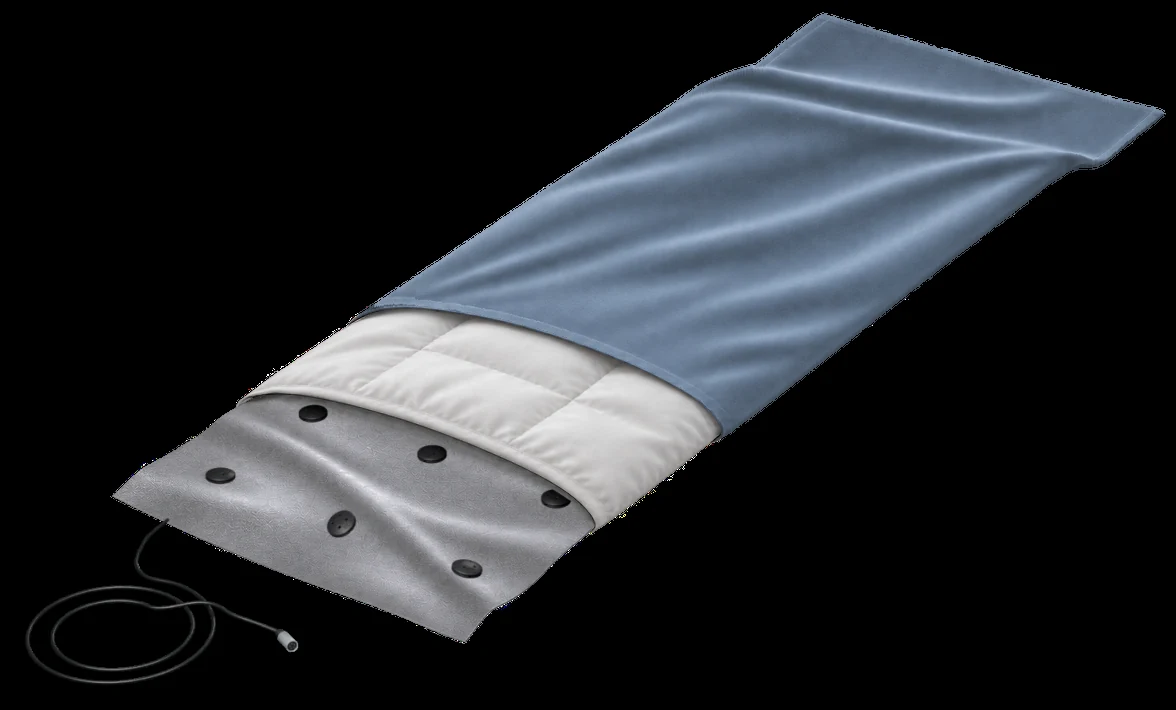
A CLOSER LOOK
Music and vibroacoustic stimulation have been studied for relaxation, anxiety, pain perception, and sleep. Here is what selected human studies found.
VIBROACOUSTIC STIMULATION
In a study of 38 adults, a vibroacoustic session lowered heart rate and increased heart-rate variability markers associated with parasympathetic activity compared with the preceding rest period.
Participants listened to a 45-minute soundscape through headphones and a bass module. The session followed a lying-down rest period. The fixed order and absence of a sham group limit what can be attributed to vibration alone; the study did not show an advantage over rest on every measure.
Read the studyFooks & Niebuhr · Sensors · 2024
MUSIC AND ANXIETY
A randomized trial involving 203 surgical patients found that listening to personally selected music during recovery reduced anxiety compared with usual care or researcher-selected Mozart.
The intervention lasted 30 minutes in a postoperative recovery setting. The study supports the value of personal music choice in that setting; it did not examine treatment of an anxiety disorder or a Sound Blanket session.
Read the studyJiang et al. · International Journal of Surgery · 2024
MUSIC AND PAIN PERCEPTION
In a randomized crossover study of 84 women, preferred music reduced the intensity and unpleasantness of experimentally induced pain and increased pain endurance compared with a podcast.
Participants listened to preferred music, classical music, and a podcast in separate conditions. This was a laboratory study of short-term electrical pain in healthy volunteers. Its findings do not establish treatment effects for chronic pain.
Read the studyBecker et al. · European Journal of Pain · 2025
MUSIC AND SLEEP
A randomized trial of 94 students with poor sleep found that relaxing music at bedtime improved self-reported sleep quality over three weeks.
Participants listened to 45 minutes of relaxing classical music or an audiobook before bed; a third group had no intervention. The benefit was measured through sleep questionnaires. This was a repeated bedtime routine, rather than a single session or a study of objective sleep duration.
Read the studyHarmat, Takács & Bódizs · Journal of Advanced Nursing · 2008
The Pro provides an electrical connection to ground. Small studies have explored grounding and sleep, stress, and pain; the clinical evidence remains preliminary.
Read the 2004 pilot studyYOUR EXPERIENCE
Ask your spa team to introduce you to Sound Blanket. Start at a low, comfortable level and let them know how it feels.
Bring the experience home Explore how Sound Blanket worksTell your host about any restrictions or concerns. Stop if you feel uncomfortable. If you use a pacemaker, defibrillator, or another magnet-sensitive implant, obtain guidance from your clinician and device manufacturer before trying the blanket. Sound Blanket is a wellness product and is not intended to diagnose, treat, cure, or prevent disease.